
How to Build a Bunker in Rust (Step by Step Guide 2026)
Learn how to build a bunker in Rust from scratch — the 3 bunker types explained, a step-by-step floor stack guide, and the most common mistakes to avoid.
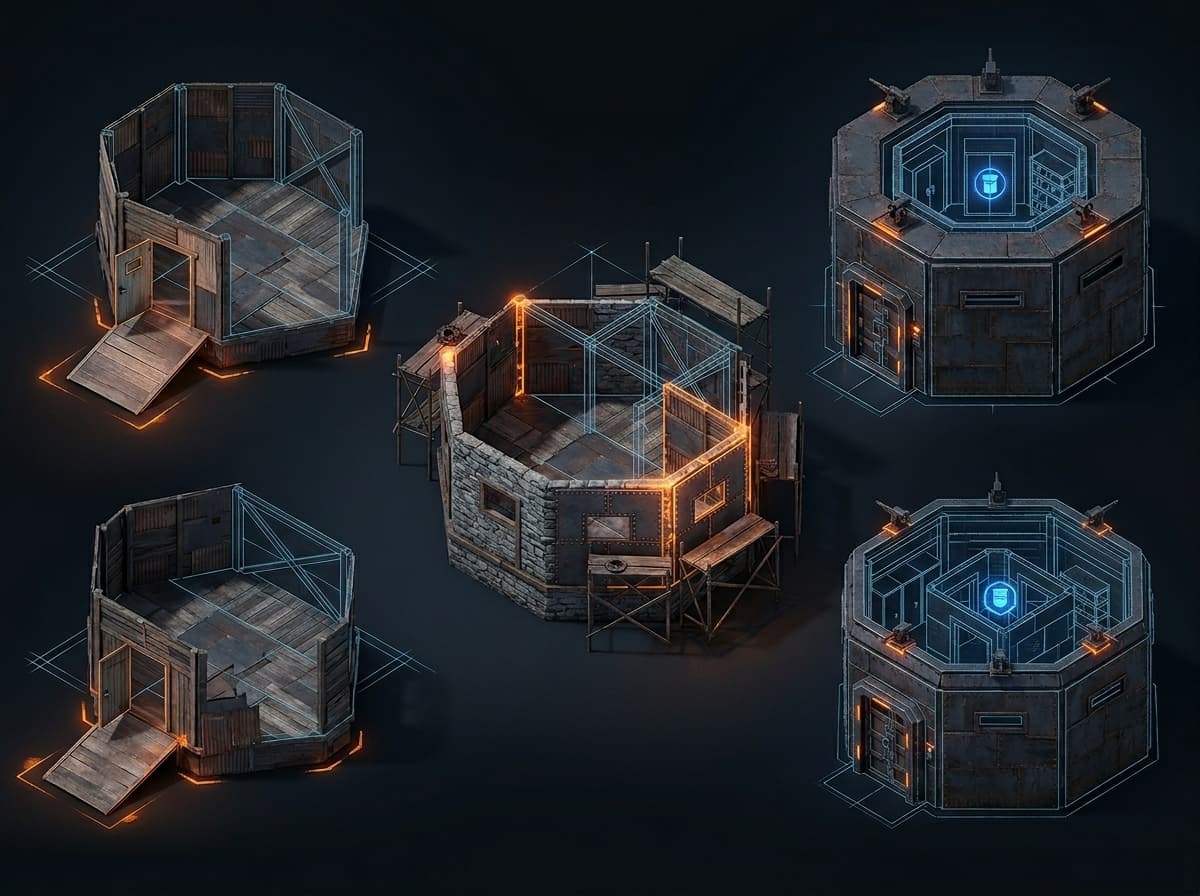
A bunker is the single most effective defensive technique in Rust. Done correctly, it creates an entrance to your base that is physically unreachable from outside — no amount of rockets opens it, because there's nothing to blow up. Raiders have to destroy your entire outer shell just to find a way in.
This guide explains exactly how bunkers work, the different types used in 2026, and how to build each one step by step.
What Is a Bunker in Rust?
A bunker in Rust is a door or set of doors placed in a specific configuration that makes them accessible only from inside the base. From the outside, the doors appear to be behind a solid wall or floor — physically out of reach.
The key mechanic is the building system's collision model. Certain foundations, walls, and floor frames can be stacked or offset so that a door sits behind a solid surface when viewed from outside, but remains fully accessible when you approach from inside.
Bunkers don't use any glitches or exploits. They're built entirely within Rust's normal building mechanics. Facepunch has intentionally kept them in the game as a core part of advanced base design.
Why Bunkers Are Worth Building
Every strong base on RustBaseLab uses at least one bunker. Here's why:
- Doors are the cheapest raid target — a standard door costs 2-4 satchels to break. A bunker removes doors as a raid target entirely
- Forces raiders to take the expensive path — instead of cracking a door, they have to break full walls
- Pairs perfectly with honeycomb — together they can push a 2x2 base's raid cost past 60 rockets
- Works at any base size — from a 2x1 solo starter to a large clan compound
- No upkeep cost — once built, a bunker adds permanent protection
The 3 Main Bunker Types in Rust (2026)
1. The Floor Stack Bunker
The most common bunker type. A door is placed on a floor frame that's been positioned so it's flush with — or behind — an outer wall when viewed from outside. From inside, you walk up to the door normally and open it.
How it looks from outside: A solid wall with no visible door gap.
How it looks from inside: A normal door you can walk through freely.
Difficulty to build: Medium — requires precise foundation placement.
Best for: 2x2 and larger bases. The most versatile bunker type.
2. The High External Wall Bunker
Uses a High External Stone or Wooden Wall placed adjacent to the base. The door is positioned so that the external wall blocks access from outside. Attackers would have to destroy the external wall (which has very high HP) before they can even reach the door.
Difficulty to build: Easy — external walls are straightforward to place.
Best for: Adding a bunker entrance to an existing base without rebuilding.
Limitation: External walls can be destroyed — this is not as permanent as a floor stack bunker.
3. The Drop Bunker
A drop bunker uses a hatch or floor opening above a door. You drop down from above to access the entrance. From ground level outside, the door is behind a wall — completely unreachable. You need to be inside and above to use it.
Difficulty to build: Hard — requires precise vertical placement.
Best for: Secondary entrances, TC rooms, loot rooms. Not ideal as a main entrance.
Example:
→ Ultimate Hidden Loot Base with Drop Bunkers
How to Build a Floor Stack Bunker — Step by Step
This is the standard bunker used in most competitive bases. Follow these steps exactly — foundation placement order matters.
What you need
- Stone foundations (or higher tier)
- A wall frame
- A door (wooden, sheet metal, or armored)
- A code lock
- Building plan and hammer
Step 1: Place your base foundation
Start with your standard base footprint. The bunker is built at the edge of the base — typically where your main entrance will be.
Step 2: Place a foundation half-step offset from the edge
Place a foundation adjacent to your entrance wall, offset by half a foundation width toward the outside. This is the key placement. The offset creates the geometry that puts the door behind the outer wall's collision model.
If the offset foundation snaps into alignment with your main foundations, rotate your building plan or try placing from a different angle. The half-offset doesn't always snap automatically.
Step 3: Build a wall frame on the offset foundation
Place a wall frame — not a solid wall — on the offset foundation, facing inward toward your base. This is where the door will go.
Step 4: Place and lock the door
Place your door in the wall frame. It should open inward, into your base. Add a code lock immediately and set your code before moving on.
Step 5: Build the outer wall
Now place a solid wall on the outermost edge of your base, in front of the door. When viewed from outside, this solid wall should completely obscure the door behind it. From inside, the door is still fully accessible.
Step 6: Test it
Walk outside your base and try to interact with the door. You should not be able to reach it. If you can still interact with the door from outside, your offset placement was incorrect — demolish and retry the foundation.
Common Bunker Mistakes
The door is still reachable from outside
Your foundation offset is wrong. The door needs to be at least one wall's thickness behind the outer wall's hitbox. Even a few units of difference can leave the door exposed. Demolish the offset foundation and try again — sometimes you need to approach from a different angle to get the half-offset to register.
The bunker blocks teammates from entering
This happens when the door's accessible side faces the wrong direction. Make sure the door opens inward (into the base) and that the accessible face is on the interior side. If teammates are getting stuck outside, the door is facing backward.
Raiders broke through anyway
They didn't use the door — they went through a wall next to the bunker entrance. A bunker protects the door, not the walls around it. You still need honeycomb on every wall adjacent to the bunker entrance. The bunker and the honeycomb work together.
Adding a Bunker to an Existing Base
You don't need to start from scratch to get a bunker. These two options work for existing bases:
- Replace a standard door entrance with a High External Wall bunker — place a High External Stone Wall in front of your existing door so it blocks access from outside. Quick to build and adds immediate protection.
- Demolish your entrance wall and rebuild with a proper floor stack — this requires having a building privilege (TC must be active) and doing it while the wall is still in the soft-side demolish window.
This design shows how a bunker integrates cleanly into an existing 2x2 build:
→ The Best Solo/Duo Bunker Base — 5 Minute Build
Bunker Base Designs on RustBaseLab
Every design below uses a verified bunker technique with a full video tutorial showing exact placement:
→ Stelic's Perfect Solo/Duo Bunker Base 2026
→ INSANE Solo/Duo Bunker Base Design 2025
→ Perfect Bunker Base for Duo/Trio
→ The Overpass — 5 Bunkers, Solo/Duo/Trio
→ POLARIS — 6 Bunkers, Duo/Trio/Quad
Browse all bunker base designs on RustBaseLab — filter by team size to find a build that fits your group: rustbaselab.com/bases